
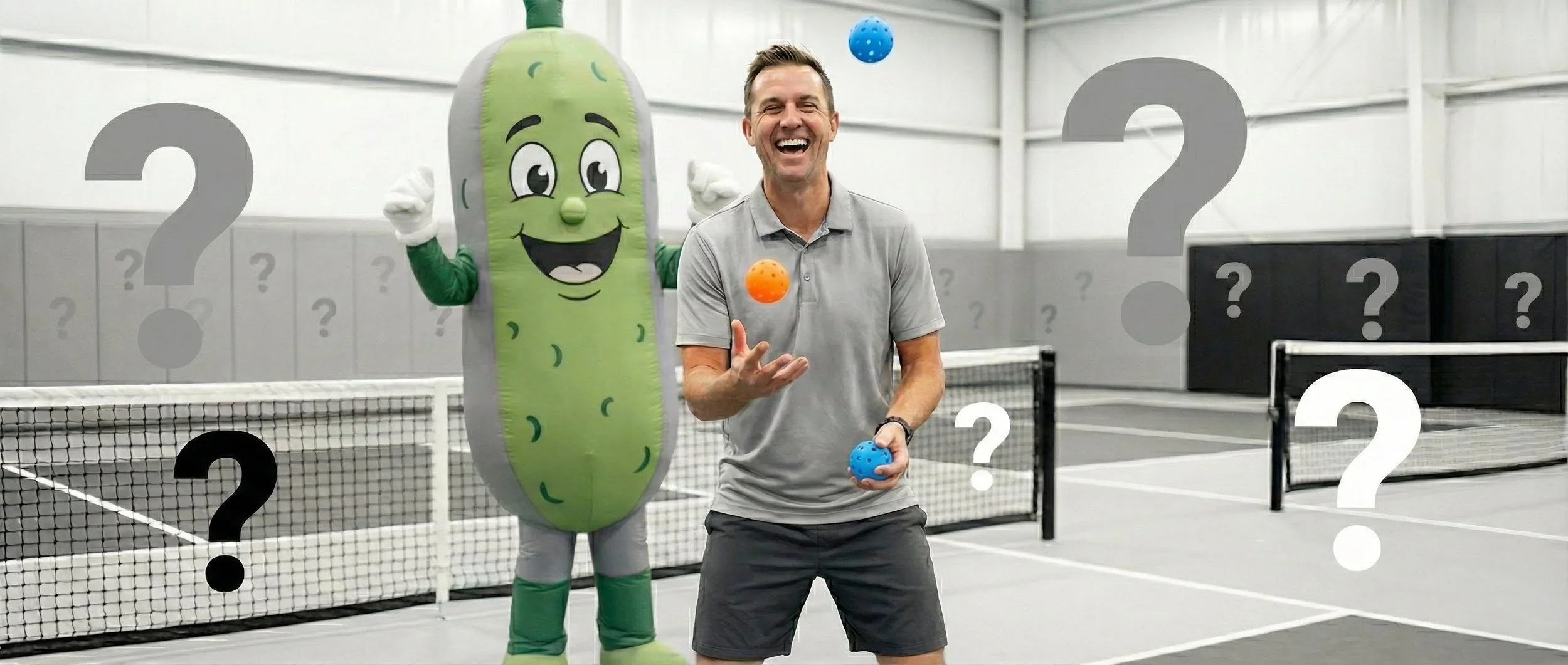
Frequently Asked Questions
-
Pickleball is the fastest-growing sport in America, and for good reason. Imagine if tennis, badminton, and table tennis (ping-pong) all got together, had a party, and decided to create the perfect, inclusive, and ridiculously addictive offspring. That's pickleball!
The Court: It's played on a badminton-sized court.
The Net: It has a modified tennis net.
The Paddle: Players use solid paddles, similar to those used in table tennis, but slightly larger.
The Ball: The star of the show is a unique, lightweight, plastic ball with holes—a.k.a., a whiffle ball.
The result is a low-impact, high-social game that can be played by anyone from 8 to 80, often at the same time. It's less about power and more about finesse, strategy, and getting a good laugh with your opponents.
-
This is the most famous pickleball mystery, and there are two main theories:
The Dog Theory (The Official Story): In 1965, the game was invented on Bainbridge Island, near Seattle, by three dads - Joel Pritchard, Bill Bell, and Barney McCallum. Pritchard's family dog, named Pickles, loved to chase the ball and would often run off with it. The family started calling the game "pickleball" after their playful pooch.
The Boat Theory (The Naughty Story): Pritchard's wife, Joan, claims she named it because the combination of different sports equipment reminded her of the "pickle boat" in rowing. A "pickle boat" (or "pickle crew") is traditionally the last boat to finish a race, made up of the leftover rowers from the other crews - a nice nod to the game being an eclectic mix of parts!
The takeaway? No literal pickles are required, but you can definitely celebrate a great point with a post-game dill spear.
-
It’s all about the power of community. We believe that pickleball is at its best when local organizations work together. which is why we utilize a partnership-based model. Rather than being tied to a single location, Paddle Up Solutions collaborates with a variety of venues to bring our services directly to you.
We proudly partner with:
Local YMCAs and community centers.
Sports & recreation venues and private indoor pickleball facilities.
Outdoor pickleball courts managed by city municipalities.
This flexible approach allows us to host corporate team-building events, coaching clinics and pickleball lessons at the most convenient and high-quality locations across the region. By partnering with existing venues, we support local infrastructure while keeping our focus exactly where it belongs: on the instruction, engagement, and growth of the players.
-
Not at all! This is the game's secret weapon: it has an incredibly low barrier to entry.
You can learn the basic rules in about 15 minutes.
The underhand serve is gentle.
The court is small, so you don't have to run like a marathoner.
The "kitchen" (the non-volley zone near the net) forces players to slow down, making strategy and dinks (soft, short shots) more important than blasting the ball.
-
Believe it or not, there are different balls depending whether you’re playing on outdoor-style asphalt courts or smooth-surface indoor courts. Indoor courts are usually lacquered wood or monolithic poured acrylic (think basketball or multi-sport courts).
Indoor balls have larger, fewer (around 26) holes. The plastic of an indoor ball is usually softer, and often come in several colors (blue, pink, purple, etc).
Outdoor balls have smaller and more (40 or 48) holes. The plastic of an outdoor ball is usually harder than an indoor ball. Outdoor balls are almost some shade of yellow.
-
Oh boy, where to start. Pickleball ratings are a hot topic nowadays. There’s actually multiple, competing rating systems/platforms out there, and the rating that matters usually comes down to which tournament or competition you are playing.
DUPR (Dynamic Universal Pickleball Rating) is currently the largest, and therefore the default rating system used.
DUPR uses a numerical rating of 2.0 (first time playing) to 8.0 (perfect record, 11-0 in every game), useing a website and app to allow players to track both their & other players’ ratings. The ratings are updated instantly as scores are entered. Scores can be entered via a tournament/competition or in rec play, provided all players agree to submitting the scores.
For you as a player, both DUPR and other ratings are free to acquire, usually by self-rating to start, and revised by the system’s algorithm once match scores start to be uploaded.